


If you’re running Google Ads campaigns in the UK, there’s a significant change on the horizon that deserves your attention now, not later. Google has confirmed that Dynamic Search Ads are being retired in favour of Google AI Max, with a final deadline of February 2027. At that point, any campaigns still running on DSA will be migrated automatically, and you’ll lose the ability to choose how that transition happens.
At Blaze Media, we keep a close eye on every Google Ads update as it rolls out, so our clients are never caught off guard by changes like this. This transition is one we’ve been tracking closely, and our paid ads team will continue to update our guidance as Google refines the platform ahead of the deadline.
What Are Dynamic Search Ads and Why Google Is Retiring Them
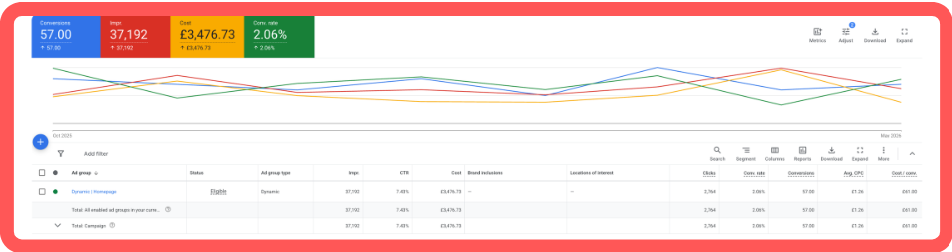
To understand what’s changing, we first need to answer: what are dynamic search ads, and how have they functioned for advertisers? Dynamic Search Ads have been a reliable automation tool for Google advertisers since their introduction, offering coverage that manual campaigns often miss. Rather than manually selecting keywords, DSA works by crawling your website and automatically matching your ads to relevant searches based on your page content.
How Dynamic Search Ads Work
The core mechanics of Dynamic Search Ads were straightforward: you gave up control over exact headlines and targeting precision, and in exchange, you got reach into long-tail searches that your main campaigns wouldn’t capture. That predictability made DSA useful for many advertisers. You knew what you were trading off, and the system behaved consistently within those parameters.
Why the DSA Retirement Matters
The retirement of Dynamic Search Ads marks a significant shift in how Google approaches automated search advertising. While dynamic ads offered predictable automation with clear boundaries, the replacement system introduces more variables and less transparency into campaign management. This isn’t just a simple upgrade or rebrand. It’s a fundamental change in how automated search campaigns operate.
What is Google AI Max and How Does it Replace DSA?
The question “What is AI Max?” is becoming increasingly important as the February 2027 deadline approaches. Google AI Max represents the next generation of automated search campaigns, replacing DSA with more advanced machine learning capabilities. But understanding what AI Max is means looking beyond Google’s marketing materials to examine how it actually functions in practice.
Intent-Based Matching Explained
In essence, AI Max for Search uses intent-based matching rather than the content-based approach that powered DSA. The system aims to find relevant, long-tail searches that traditional keywords might fail to capture by analysing user behaviour patterns and search context. The Google Ads AI technology behind AI Max analyses auction signals in real time, making decisions about when and how to show your ads based on predicted user intent rather than just matching queries to your website content.
That sounds like a logical evolution of search advertising technology, and in some ways it is. However, early testing of Google AI Max shows both promising results and areas that require careful monitoring before you commit your budget.
How Google AI Max Differs from Traditional Search Campaigns
Here’s where things get interesting, and where advertisers migrating to Google AI Max need to pay close attention.
Keyword Match Types Behave Differently in AI Max
Research by PPC expert Brad Geddes has documented that AI Max effectively treats all your keywords as broad match, regardless of their actual match type. This means the system will expand into territory your existing exact and phrase match keywords already cover, and it will attribute those conversions to itself.
What Google reports back as AI Max performance therefore needs scrutinising before you take it at face value. This behaviour implies that some of those “wins” were already happening without AI Max. They’re just being re-attributed to the new campaign type. Your tightly controlled exact match keywords, the ones you’ve refined over months or years, suddenly get the widest net cast around them.
This isn’t speculation or theory. Roughly 80% of AI Max’s query expansion traces back to Exact Match keywords, not Broad Match ones. If you’re not actively monitoring the search term report after migrating, you may not notice the impact until your cost per acquisition has already shifted significantly. Our guide to conversion tracking covers why clean data is so important when platforms like this are making decisions on your behalf.
URL Expansion Changes Where Your Traffic Lands
The other major difference involves URL expansion. Moving beyond dynamic ads means accepting that AI Max will send traffic to whichever page Google determines is the best match for a given search. On a real website with multiple page types, that can mean your blog posts, your contact page, or your homepage rather than your carefully optimised product landing pages. If you had page exclusions set up in your DSA campaigns to prevent this, they don’t carry over automatically and will need to be rebuilt manually inside AI Max.
AI Max Google Ads Performance: What the Data Actually Shows
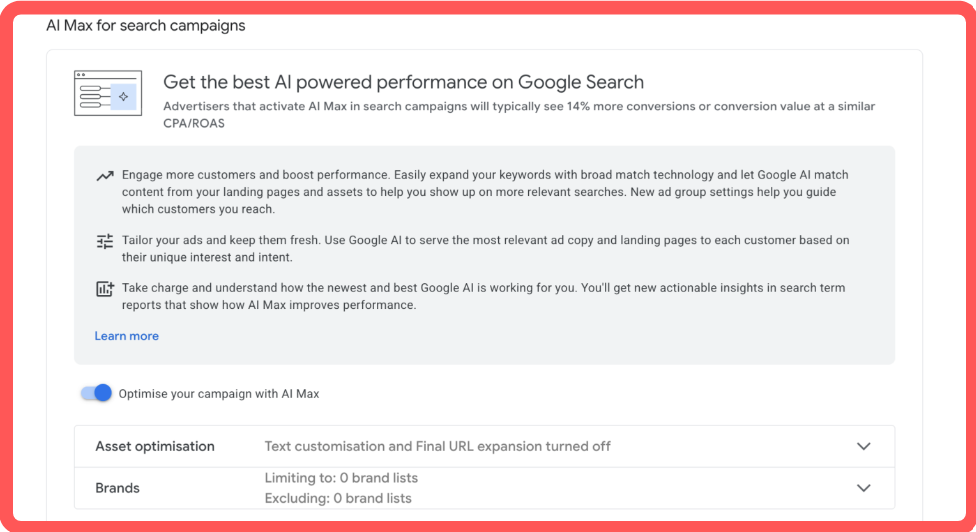
Google’s official figures suggest a 14% lift in conversions at a similar cost per acquisition. That’s not a fabricated number, but it’s also not the complete picture. The performance data for AI Max Google Ads reveals a more nuanced reality when you look at independent analysis.
Independent AI Max Performance Data
Smarter Ecommerce ran an analysis across more than 250 Search campaigns and found a median revenue lift of 13%, which is broadly consistent with Google’s headline figure. The catch is that the median CPA rose 16% at the same time, and only 22% of campaigns landed anywhere near their original ROAS targets. That’s a significant detail that changes how you should evaluate the “success” of a migration.
Why Reported Performance Can Be Misleading
Many advertisers testing AI Max Google Ads have noticed unexpected query expansion patterns that inflate reported performance. When the system attributes conversions that were already happening through your existing campaigns, the lift looks impressive on paper but doesn’t represent genuine incremental growth. Anyone promising you certainty on AI Max performance right now is getting ahead of what the evidence actually supports.
This doesn’t mean AI Max won’t work for your campaigns. It means you need to approach migration with realistic expectations and proper measurements in place. The 14% conversion lift is achievable, but it may come with trade-offs in efficiency that aren’t immediately obvious from Google’s promotional materials.
Preparing for Your AI Max for Search Migration
Before migrating, you should consider the following:
Expect Expansion on Your Most Precise Keywords
First, as mentioned, your most precisely defined keywords are the ones getting the widest expansion. How Google Ads AI interprets keyword match types differs significantly from traditional campaign behaviour, which means your historical understanding of how campaigns perform may not translate directly. For a broader look at how negative keywords can help you keep control, our guide is worth revisiting before you migrate.
Manage URL Expansion Actively
Second, URL expansion requires active management. Migrating to AI Max for Search means accepting that the system will make landing page decisions for you, and those decisions won’t always align with your conversion optimisation strategy. You’ll need to rebuild page exclusions manually and monitor where traffic actually lands, not just assume it’s going to your intended pages. Our ultimate guide to landing page optimisation is a useful reference here.
Review Conversion Tracking Before You Migrate
Third, conversion tracking needs to be reviewed before migration, not after. If your tracking isn’t capturing the full customer journey or if you’re relying on outdated attribution models, AI Max will optimise toward incomplete data. The system is only as good as the signals you’re feeding it.
Make the Search Term Report Part of Your Routine
Fourth, the search term report becomes more critical, not less. With traditional campaigns, you could set match types and have reasonable confidence about query coverage. With AI Max, you need to actively monitor what searches are actually triggering your ads, because the system will expand in ways you might not predict or want.
Your DSA to AI Max Migration Timeline Before February 2027
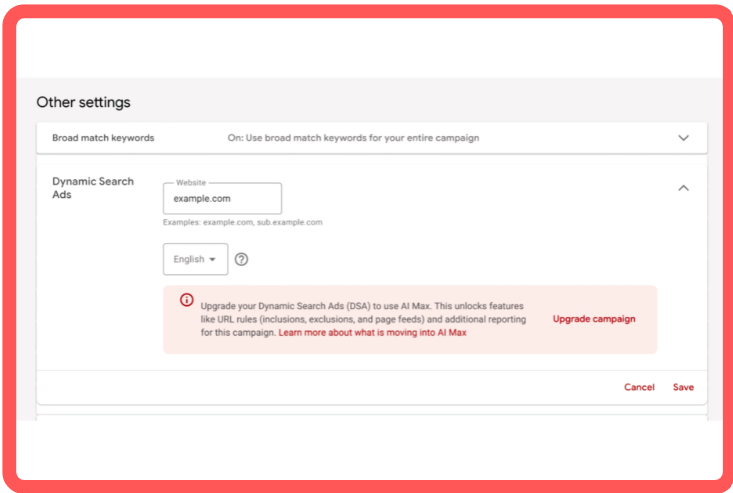
The timeline to keep in mind: new DSA campaign creation gets blocked in January 2027, and automatic migration begins in February 2027. If you’re currently running Dynamic Search Ads and you’re still on them when the automatic migration kicks in, Google’s own developer documentation states that remaining campaigns could be moved to Performance Max rather than AI Max for Search. Those are not the same thing, and you lose the ability to choose which system your campaigns move to.
The Case for Managing Your Own Migration
That’s a strong reason for managing your own migration rather than waiting for Google to do it for you. Moving across voluntarily means you can properly review your conversion tracking, check URL expansion settings, rebuild any exclusions that would otherwise be lost, and run a proper experiment before committing your full budget.
Using the One-Click Upgrade Tool
The one-click upgrade tool in Google Ads preserves historical data and should minimise the learning phase, which makes the transition smoother than starting campaigns from scratch. But “smoother” doesn’t mean “automatic”. You still need to actively manage the process and monitor performance closely in the weeks following migration.
Setting up AI Max Google Ads requires understanding these technical requirements upfront. Don’t assume that because it’s positioned as an upgrade, it will automatically perform better. The data suggests it can perform well, but only when properly configured and actively monitored. For a broader view of how Google Ads has been evolving, our post on how to set yourself up for success on Google Ads is a solid foundation.
What the AI Max Transition Means for UK Advertisers
This transition is part of a broader shift Google has been making for some time, moving advertisers from manual controls toward AI-driven systems. These transitions tend to go well when the setup going in is clean, conversion tracking is accurate, and the new controls are actively used. They tend to go badly when campaigns are left to run on autopilot with the assumption that “AI will figure it out.”
The reality is that Google Ads AI technology is powerful, but it’s not magic. It needs good data, clear conversion signals, and active management to deliver results. If your current DSA campaigns are performing well, don’t assume that AI Max will automatically maintain or improve that performance without proper setup and monitoring.
For UK advertisers specifically, this means starting your migration planning now, not in late 2026. Run side-by-side tests while you still can. Compare performance across both systems with realistic measurement. Understand where AI Max is genuinely adding value versus where it’s re-attributing existing performance. Make the migration decision based on your data, not Google’s promotional materials.
How to Prepare for the February 2027 Deadline
If you’re running Dynamic Search Ads currently, here’s what you should do before the February 2027 deadline.
Audit Your Existing DSA Campaigns
Start by auditing your existing DSA campaigns to understand what’s actually driving performance. Document your page exclusions, conversion tracking setup, and current performance benchmarks. These will be your reference points for evaluating AI Max’s performance.
Run a Side-by-Side AI Max Test
Next, create a test AI Max campaign alongside your existing DSA campaigns while you still have the option. Run them in parallel for at least 4-6 weeks to gather meaningful data. Monitor the search term reports closely to see where query expansion is happening and whether it’s beneficial or wasteful.
Check Your Conversion Tracking Setup
Review your conversion tracking to ensure it’s capturing the full customer journey. AI Max will optimise toward whatever signals you give it, so if your tracking is incomplete, your results will be too.
Rebuild Your Page Exclusions
Rebuild your page exclusions manually in AI Max. Don’t assume they’ll carry over or that the system will automatically avoid sending traffic to inappropriate pages.
Decide Based on Your Own Data
Finally, make your migration decision based on your own data, not industry averages or Google’s headline figures. What works for other advertisers may not work for your specific campaigns, products, or audience.
Plan Your Google AI Max Migration with Blaze Media
The move from Dynamic Search Ads to Google AI Max is manageable, but it rewards preparation and punishes autopilot. The advertisers who come out of this transition ahead will be the ones who tested early, measured properly, and made the switch on their own terms rather than waiting for Google to make it for them.
That’s exactly the kind of work our in-house PPC team does every day. At Blaze Media, we stay on top of every Google Ads change so you don’t have to. We’re already reviewing affected campaigns ahead of the February 2027 deadline, flagging anything that needs attention and building migration plans backed by real performance data.
If you’re running Dynamic Search Ads and want a clear, evidence-led plan for the switch to AI Max, get in touch with the Blaze Media team today.
We’ll audit your current setup, run the right tests, and make sure your campaigns land on the other side of this transition performing better than before.