



The way people shop online is changing.
For years, the ecommerce journey has followed a familiar pattern. A customer searches Google, sees an organic result or advert, visits a website, compares products and eventually checks out.
AI shopping agents are beginning to challenge that model.
Instead of visiting several websites to find the right product, shoppers can increasingly ask an AI assistant to research their options, compare prices and specifications, check availability and, in some cases, help complete the purchase.
This emerging model is known as agentic commerce, and developments from Google, OpenAI, Meta, Shopify and Amazon suggest it could significantly change ecommerce marketing over the next few years.
At Blaze Media, we’ve been following this update closely; keep reading to find out what we know right now based on the information released.
What Are AI Shopping Agents?
AI shopping agents go further than traditional chatbots.

A chatbot might answer a question about delivery or recommend something from an existing catalogue. An AI agent can potentially research products across different retailers, understand multiple requirements, compare options and take actions on the shopper’s behalf.
That means a traditional journey such as:
Search → Website → Product Page → Basket → Checkout
could increasingly become:
Ask AI → Compare → Buy
The technology is still developing, and conventional search remains far larger than AI referral traffic today. However, Shopify says AI-driven traffic to its stores increased more than eightfold year on year in Q1 2026, while orders originating from AI-powered searches grew almost 13 times.
The important point for ecommerce businesses is not that websites or search engines are disappearing. It is that a new layer is appearing between the customer and the retailer.
Google Is Building an Agentic Shopping Ecosystem
Google is arguably making one of the most significant moves into agentic commerce because it already plays such a large role in product discovery.
Its approach goes well beyond simply asking Gemini for a product recommendation.
The Universal Commerce Protocol (UCP)
Google has developed the Universal Commerce Protocol, or UCP, alongside Shopify and other major retailers. UCP gives AI agents, merchants and payment systems a common way to communicate across product discovery, real-time pricing, inventory, baskets, checkout and post-purchase activity.
Google’s Universal Cart
Google is using that infrastructure to build its Universal Cart, an intelligent shopping cart that works across retailers and services including Search and Gemini, with YouTube and Gmail expected to follow.
Shoppers can add products while researching, receive price-drop and stock alerts and, where supported, complete checkout directly through Google Pay or transfer their basket back to the retailer. Google says its Shopping Graph now contains more than 60 billion product listings.
What It Means for Shopping Ads
The advertising implications are equally important.
Google is bringing UCP-powered checkout into Direct Offers and Shopping ads, meaning the gap between seeing an advert and completing a purchase could become considerably smaller.
It is also testing Business Agent within YouTube ads. Eligible retailers can allow viewers to ask product questions directly inside the advert and receive tailored answers without leaving YouTube.
Historically, the primary job of an ecommerce advert has been to earn the click.
Increasingly, the advert itself could help answer objections, explain a product and move the customer closer to a purchase.
OpenAI Is Combining Shopping and Conversational Advertising
OpenAI is developing a similar model through ChatGPT.
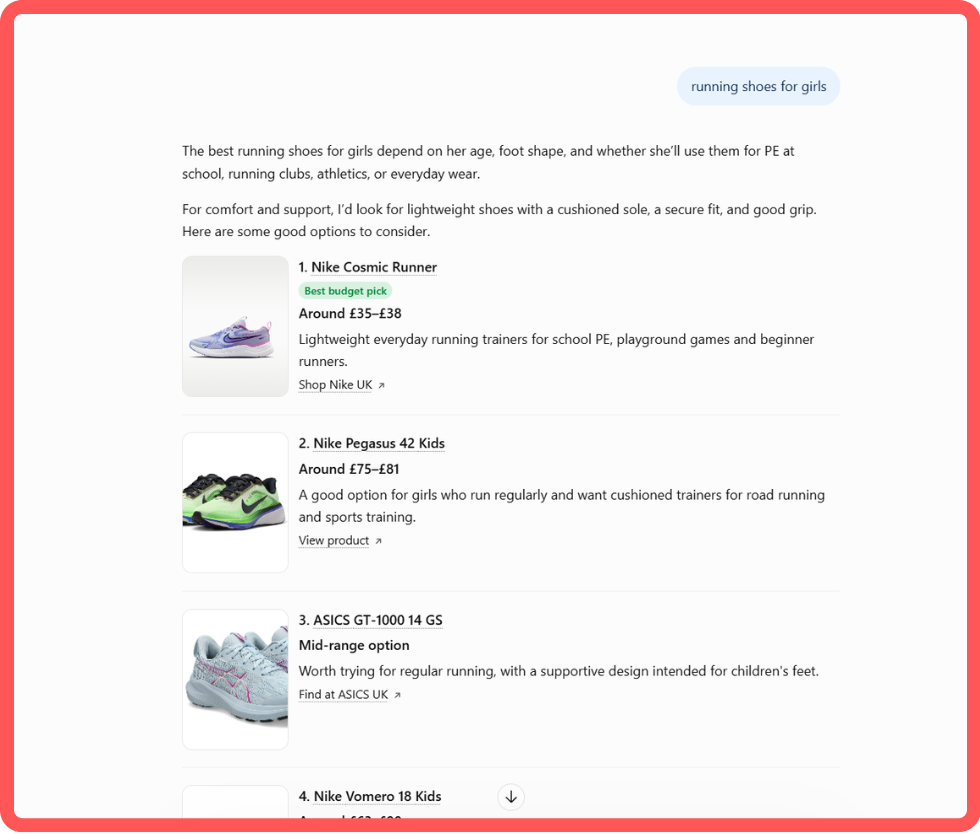
Its shopping experience allows users to describe what they need, compare products visually and receive current product information from merchants. OpenAI’s Agentic Commerce Protocol helps retailers provide structured product feeds and promotions directly to ChatGPT.
For eligible products, ChatGPT can already support checkout without requiring the shopper to begin their journey through a traditional search engine. Shopify merchants can also make their products discoverable through Shopify Catalog.
OpenAI has also recently introduced Sponsored Agents within ChatGPT Ads. Instead of simply clicking an advert and landing on a website, a user can begin a conversation with an AI representative of the advertiser and ask questions about its products or services.
Sponsored Agents are currently limited to selected advertisers in an alpha test, but they show where conversational advertising could be heading.
For ecommerce brands, that creates a completely different advertising challenge.
Success may eventually depend not only on which ad earns the click, but on how effectively an AI representative answers questions, recommends products and guides a potential customer through their decision.
Meta Muse Adds Another Shopping Agent
Meta has also entered the race with Muse, its new personal AI agent.
Muse can perform actions on behalf of users including shopping, making transactions, booking travel and sending emails. It is designed to act rather than simply answer questions.
For Meta, that is particularly interesting because Facebook and Instagram already play a major role in product discovery.
If a customer can move from discovering something through Meta to asking Muse to research it and potentially completing the purchase, the platform gains influence over far more of the ecommerce journey.
Shopify has also added Meta to its Agentic Storefronts ecosystem, allowing eligible merchant products to be surfaced through AI channels and supporting Shopify-powered direct checkout on participating platforms.
Shopify Wants Merchants Available Everywhere
Shopify’s strategy is slightly different.
It does not need to become the AI assistant consumers choose. Instead, it wants Shopify merchants to be available whichever assistant wins.
Its Agentic Storefronts connect merchant products with ChatGPT, Google AI Mode and Gemini, Microsoft Copilot and Meta. Shopify Catalog provides structured product information to these platforms, while merchants can manage participating AI channels centrally within Shopify.
That is a potentially powerful position.
Rather than asking ecommerce brands to build separate integrations for every emerging AI platform, Shopify is positioning itself as the infrastructure sitting underneath them.
It also reinforces something marketers should already be paying attention to: product data is becoming a marketing asset.
Amazon Shows Why the Future Might Not Be Completely Open
Amazon offers an interesting counterpoint.
It clearly believes in AI-led shopping and is developing its own shopping assistants, but it has recently blocked Meta’s Muse from accessing and purchasing products through Amazon.
The dispute highlights a major question surrounding agentic commerce: who owns the customer relationship?
If a shopper asks Muse to purchase an Amazon product, Meta potentially controls the customer interface while Amazon becomes the fulfillment layer behind it.
Amazon has spent decades building its own product discovery, advertising and customer-data ecosystem, so giving an external agent unrestricted access could weaken that position.
This suggests the future may not consist of AI agents freely shopping across every website.
Some retailers will open their infrastructure. Others may restrict access, prioritise their own agents or require commercial agreements before allowing third-party systems into the shopping journey.
Ecommerce SEO Is Expanding Into Product Data Optimisation
This shift has major implications for SEO.
Traditional ecommerce SEO still matters. Product pages, category pages, organic rankings, backlinks and useful content are not becoming irrelevant.
But optimisation is expanding.
AI agents need accurate product names, structured attributes, pricing, stock information, delivery details, reviews, returns policies and other data before they can confidently recommend a product.
Consider a shopper asking:
“Find me a red waterproof women’s walking jacket under £120, available in size 12 and deliverable before Friday.”
A generic product description and well-written title may not provide enough information.
The agent needs to understand colour, size availability, features, price, stock and delivery.
Merchant Center feeds, schema, Shopify Catalog, product attributes and inventory accuracy therefore become increasingly important parts of ecommerce visibility.
The SEO question is no longer only:
Can Google rank this product?
Businesses also need to ask:
Can an AI agent understand it well enough to recommend it?
Paid Media Is Expanding Beyond the Landing Page
AI commerce could have an equally significant impact on PPC.
Search advertising has traditionally been about matching an advert to intent and convincing somebody to click.
Google’s Business Agent, UCP-powered Shopping ads and Direct Offers, alongside OpenAI’s Sponsored Agents, suggest another model is emerging.
An advert could increasingly become an interactive sales environment.
A potential customer might ask whether a product fits their requirements, compare models or clarify delivery options without initially visiting the retailer’s website.
For paid media teams, campaign strategy may therefore expand beyond targeting, creative and landing-page optimisation.
The quality of product feeds, conversational information and the answers provided by AI systems could become part of ad optimisation too.
There Are Still Major Questions to Answer
Agentic commerce is moving quickly, but plenty remains unresolved. Amazon blocking Muse shows that platform access cannot be assumed.
There are also concerns around privacy and trust. Muse, for example, can require access to substantial amounts of personal information to perform tasks effectively, and Meta has already faced questions around privacy as it experiments with more advanced agent features.
Recommendation neutrality will matter too. As Google, OpenAI and other platforms combine AI recommendations with advertising products, consumers and brands will want to understand why one product was recommended over another.
OpenAI currently states that ChatGPT shopping results are selected independently from its advertising products, but maintaining clear separation between organic AI recommendations and paid placements is likely to become increasingly important as these ecosystems grow.
What Should Ecommerce Businesses Do Now?
There is no reason to rebuild an ecommerce strategy around AI agents overnight. Organic search remains the dominant discovery channel for Shopify merchants, and many agentic shopping features are still rolling out or limited to selected markets.
But ecommerce businesses should start preparing. Product feeds should be detailed and accurate. Structured data needs to be maintained properly. Prices, inventory, product attributes, delivery information and return policies should be easy for machines as well as people to understand.

Brands should also begin monitoring traffic and revenue originating from platforms such as ChatGPT, Gemini, Copilot and other AI tools.
Most importantly, businesses need to stop assuming that their website will always be the first place a potential customer encounters their products.
The Future of Online Shopping Is Becoming More Agentic
Websites are not going away.
Customers will continue to browse stores, read reviews, compare ranges and interact directly with brands. Businesses will still want to own their websites because they provide control over the customer relationship, data and post-purchase experience.
But the website may increasingly become one destination within a much larger shopping journey.
AI assistants are positioning themselves between discovery and purchase, deciding which products deserve consideration and, increasingly, helping customers complete the transaction.
For ecommerce businesses, the challenge is therefore expanding.
It is no longer enough to make sure your products rank, advertise and convert.
You also need to make sure that when someone asks an AI assistant what they should buy, your products can be found, understood and confidently recommended.
Prepare Your Ecommerce Site With Blaze Media
At Blaze Media, we’re already monitoring how AI search, paid advertising and agentic commerce are changing ecommerce discovery. As these platforms develop, successful ecommerce strategies will need to optimise for people, search engines and AI agents at the same time.
Do you want to ensure your ecommerce site is discoverable, or do you just want to know about this update? Get in touch with the Blaze team to find out more.