



For about two decades, paid search meant one thing: Google. You bid on keywords, you wrote three headlines and a couple of descriptions, and you fought over the same blue links as everyone else. Meta came along and gave us the feed. And that was more or less the map. Search, social, maybe a bit of retail media if you were feeling fancy.
That map is now out of date, and it’s part of a much bigger shift in how search is changing. In 2026, ads have arrived inside the AI assistants people are actually talking to, and the biggest of them all, ChatGPT, is already serving sponsored placements to UK users. If your marketing plan doesn’t have a line in it for “what do we do about AI ads,” it’s going to need one soon.
Here at Blaze, we don’t just read about these things; we run them. We’re actively testing ChatGPT Ads, so what follows isn’t theory pulled off someone else’s blog. It’s the honest, jargon-free rundown of where AI advertising actually is right now, what it’s genuinely like to run, and whether your business should be doing anything about it yet.
ChatGPT Ads Have Arrived
OpenAI started testing sponsored placements inside ChatGPT in the US in February 2026, and things have moved fast since. Ads were launched in the UK on 6 June 2026, making it OpenAI’s first European market. Importantly, ads show only to people on the free and lower-cost “Go” tiers, so anyone paying for Plus, Pro, Business, or Enterprise stays ad-free.
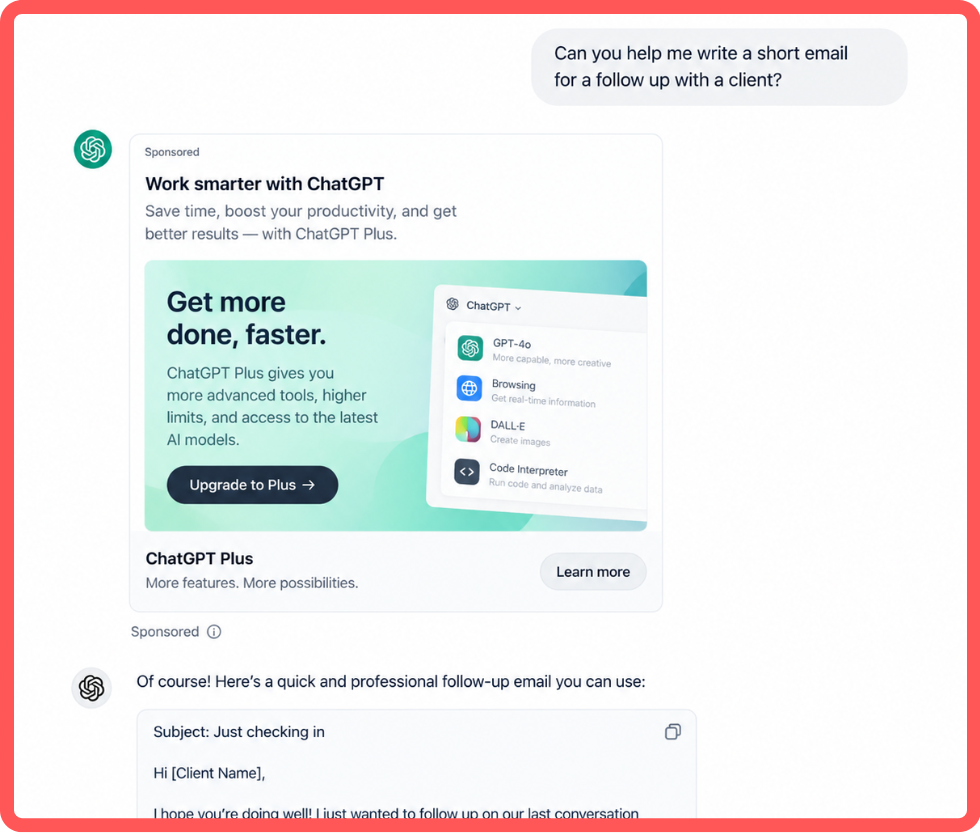
That still leaves an enormous audience, since most ChatGPT users are on the free plan.
The format itself is deliberately restrained, at least for now. A sponsored placement appears in a clearly labelled, subtly shaded box, usually at the bottom of an answer, containing a business name, an image, a headline and a short description.
OpenAI has been very keen to stress that ads don’t influence the actual answer ChatGPT gives you. The chat model and the ad system run separately. Whether that separation holds as the money gets bigger is one of the more interesting questions in our industry, but that’s the promise on the table today.
How is ChatGPT Ads Different from Google Ads?
This is the bit that matters, and it’s easy to miss if you treat ChatGPT Ads as “just another placement.”
On Google, you bid on keywords. Someone types “emergency plumber Liverpool,” and you compete to appear against that exact search. It’s intent, but it’s intent squashed into a short query.
ChatGPT works differently, and this is the part that takes some getting used to.
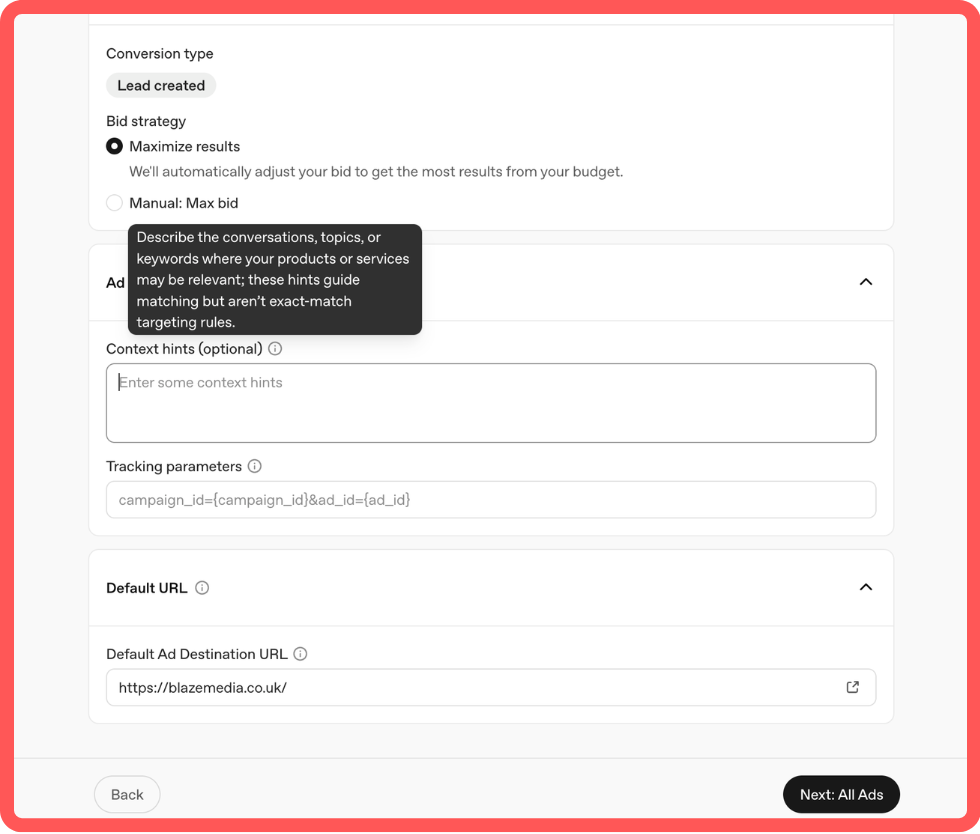
There are no keywords to bid on. Instead, you write what OpenAI calls “context hints”, plain-English descriptions of what your product offers, who it helps, and when it’s useful. So rather than bidding on “running shoes,” you’d write something like “cushioned everyday running shoes for beginners training for their first 5K.” OpenAI’s systems then use those hints to work out when your ad might be relevant to a conversation.
And here’s the crucial bit that trips people up: context hints are not targeting rules.
They are not exact-match keywords; they are not audience controls, and they do not guarantee your ad shows for any particular word, topic or type of person. They’re a nudge, not a lever. You’re describing the situations your product fits and trusting OpenAI’s system to find them.
The upside is that you’re potentially reaching someone mid-conversation, while they’re weighing up options and genuinely working through a decision, which is a richer kind of intent than a single three-word Google search.
The drawback is the lack of control: ads are placed dynamically through fluid AI conversations, without traditional auction systems or specific placement parameters, so you have little control over how your ad is used and who sees it.
How Much Do ChatGPT Ads Cost in the UK?
OpenAI ads have moved on from the early “managed pilot” days when access ran through the big agency holding companies and their household-name clients. There’s now a self-serve Ads Manager, which means any UK business can set up an account and launch a campaign directly, with no six-figure commitment and no waiting for an agency to let you in.
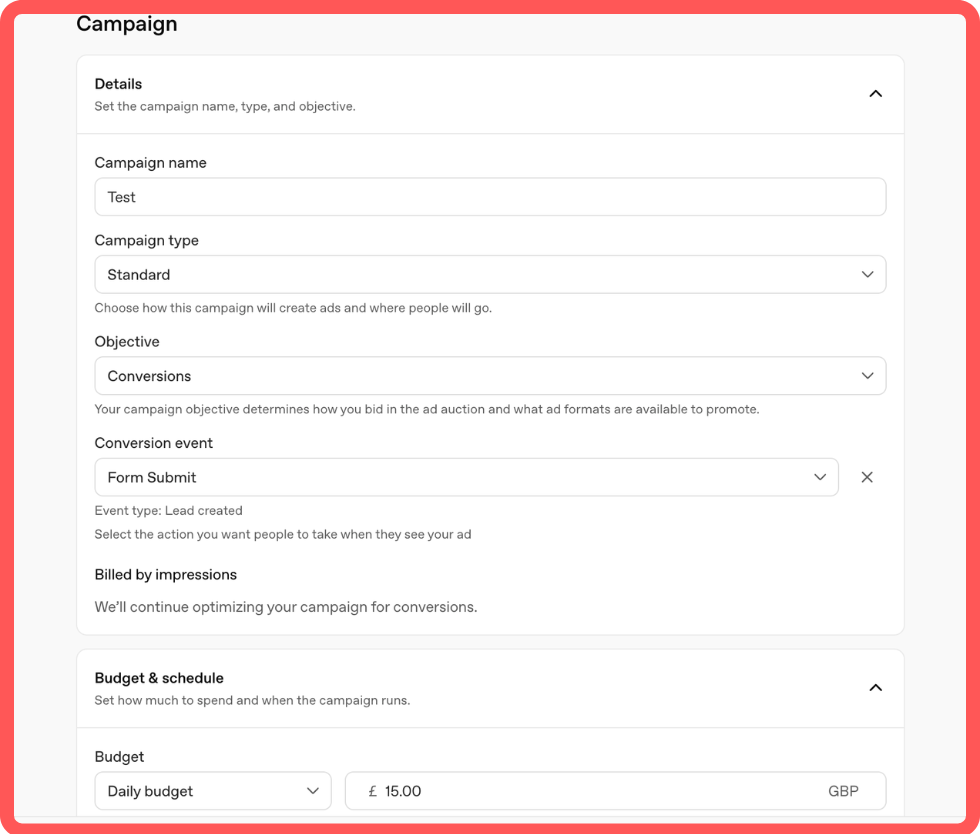
The minimum spend in the UK is £15 per day. That’s genuinely accessible for a small business that wants to test the waters. You can set either a daily budget or a total campaign budget, choose your objective (paying per thousand impressions, per click, or optimised toward a conversion), and pick which countries you’re targeting.
So the honest answer for any UK business today is: you can log in and launch this afternoon. The far more interesting question is whether you should, and that comes down to the caveats.
What Nobody Tells You About ChatGPT Ads
We at Blaze are internally testing OpenAI ads at the moment, so we can be straight with you about the bits the excitable LinkedIn posts skate over.
You Get Almost No Attribution
This is the big one. With Google Ads, you can see exactly which search terms triggered your ad, right down to the individual query.
With ChatGPT Ads, you get nothing like that. You don’t see which conversations your ad appeared in, what people were actually asking about, or which context hints did the heavy lifting. You’re flying with a lot less instrumentation than you’re used to, and for PPC people who live and breathe search-term reports, this initial setup is far from ideal.
There’s No Proper Targeting, Just Context Hints
As we covered above, you’re describing when your product is useful and hoping the system matches it well.
You can’t guarantee your ad shows for a specific topic, and you can’t exclude the ones you don’t want in the granular way you can on Google. It’s a blunter instrument.
That’s fine for awareness and testing, but if you’re used to surgical control over exactly who sees what, temper your expectations.
The Platform is Still Being Built in Public
OpenAI changes things week to week, features that are announced aren’t always live, and reporting is still fairly thin. This is early-days advertising, with all the rough edges that implies.
None of this makes it a bad channel. It makes it an early channel, and early channels reward the businesses willing to learn while the competition is still thin, as long as you go in with your eyes open about what you can and can’t measure.
How to Set Up an OpenAI / ChatGPT Ad
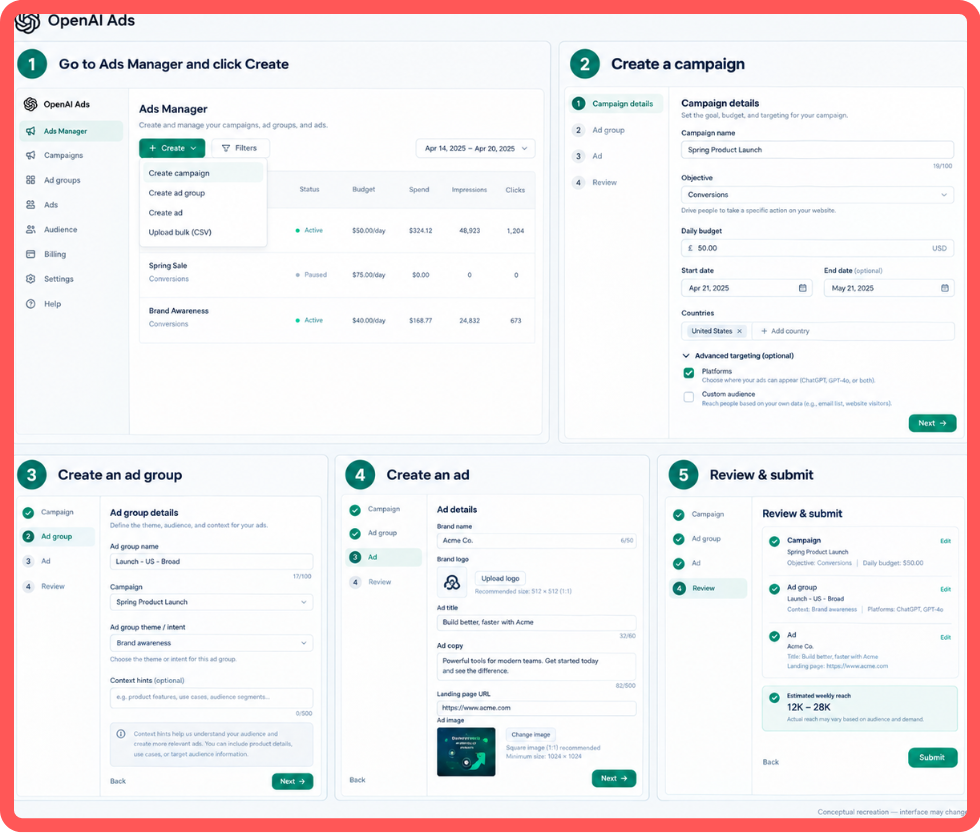
If you’ve built a Google Ads campaign, the structure will feel familiar. You’ve got campaigns at the top (where you set your objective, budget, dates and countries), ad groups underneath (each one a theme, with its context hints), and then the individual ads.
The ads themselves are refreshingly simple, almost brutally so. Each one is a brand name, a logo, an image, a short title, a line of copy and a landing page.
And when we say short, we mean it: titles are recommended at around 16 to 24 characters and capped at 50, with the copy recommended at roughly 32 to 48 characters. That’s tighter than a Google headline. There’s no room for filler; every ad has to say something clear and useful in barely more than a few words.
OpenAI’s own recommendation is to write benefit-focused copy that spells out the practical value of what you offer, who it’s for and when it helps, rather than leaning on a clever line or a generic “shop now.”
It also rewards volume and variety: several distinct ads per offering, each taking a different angle, gives the system more chances to find a relevant moment. So the winning approach is less “craft one perfect ad” and more “give it a good spread and let it learn.” That said, how wide a spread you can realistically run depends on your daily budget: on £15 a day there’s only so much delivery to go around, so keep your variations tight and focused rather than spreading a small budget thin across a dozen ads.
Two practical notes from actually running these. First, point each ad at the most relevant page on your site, not your homepage, and add your own UTM tracking, since that’s really the main way you’ll piece together what’s working given the limited native reporting.
Second, expect a lag: results can take up to around seven hours to show in the dashboard, so resist the urge to judge performance in the first hour and start yanking levers.
It’s not just ChatGPT
ChatGPT gets the headlines, but the real story is that the whole AI landscape is fragmenting into different advertising approaches, and each of the major players has picked a different lane.
ChatGPT (OpenAI) is the aggressive one, building out a full advertising business at speed, complete with performance bidding and tools for uploading your own audiences and generating creative.
Google isn’t putting traditional ads inside its Gemini assistant (just yet), but it is weaving ads through its AI-powered search experiences, its AI Overviews and AI Mode. So if you’re already running Google Ads with AI-powered features enabled (PMAX, AI Max, Broad Match, etc.), you’re arguably in AI advertising whether you realised it or not. This is why keeping on top of Google’s constant changes matters so much.
Microsoft Copilot serves ads automatically through the existing Microsoft Advertising system, which is a quietly underrated channel that a lot of agencies ignore entirely.
Perplexity tested ads and then pulled back, choosing to position itself as the ad-free, subscription-funded alternative.
Claude (Anthropic) has stayed deliberately ad-free.
Are ChatGPT Ads Worth It for Your Business?
This is the question we actually care about, because “there’s a shiny new platform” is not a reason to spend money.
For most small and medium UK businesses, the honest advice is: test it deliberately, don’t bet the budget on it. Here’s what that looks like in practice.
Get your organic AI presence in order. Paid isn’t the only way into a ChatGPT answer. The other route is to be genuinely worth citing, through strong content, a solid reputation, good reviews, and the kind of authority that makes an AI model mention you unprompted.
That work, sometimes called GEO (generative engine optimisation), overlaps heavily with good SEO and is valuable whether or not you ever buy a single AI ad. Paid and organic reinforce each other here, just as they do on Google.
Understand your Google Ads exposure. Since Google is already blending ads into its AI search experiences, and since AI-powered features like Performance Max, AI Max and Broad Match are increasingly the default, your existing campaigns are probably already a part of the AI advertising world whether you meant them to be or not.
Making sure those are healthy and well-managed is still the highest-value paid work most businesses can do.
Run a small, honest ChatGPT test. At £15 a day, you can genuinely learn this channel without risking much. Run it for two weeks with a budget you’re comfortable spending to understand how it works, not necessarily to turn a profit.
Because the attribution is so limited, set your expectations around what you can see (spend, impressions, clicks, and conversions, with no keyword or chat-level data behind them). There’s a real first-mover advantage in understanding the platform while competition is thin.
Don’t move your core budget over. A channel with limited measurement and a format still being built in public is not where a small business should be putting the bulk of its spend.
Test with money you can afford to learn with, keep your proven channels doing the heavy lifting, and scale into ChatGPT only if and when the numbers justify it.
How Paid Search is Set to Change
Paid search spent twenty years being predictable. It isn’t anymore. The paid search landscape is about to dramatically shift with a growing set of AI-powered surfaces, each with its own rules, each on its own timeline, and OpenAI / ChatGPT Ads gives us clues as to where things are heading.
For UK businesses, the smart move isn’t to throw the budget at a shiny new platform, nor to ignore it until everyone else has caught up.
It’s to run a small, deliberate test while the channel is not yet widespread and entry costs are still low, and to judge what you find on real profitability rather than vanity metrics and hype.
Since we at Blaze Media are running ChatGPT Ads ourselves, we’re doing that learning in real time, caveats and all, so our clients don’t have to work it out from scratch.
If you’d like to talk through what AI advertising could mean for your business, or you just want your current paid campaigns given a proper once-over before the landscape shifts again, get in touch.
Our in-house paid advertising experts are here to make sure your media budget is put to work where it counts.