



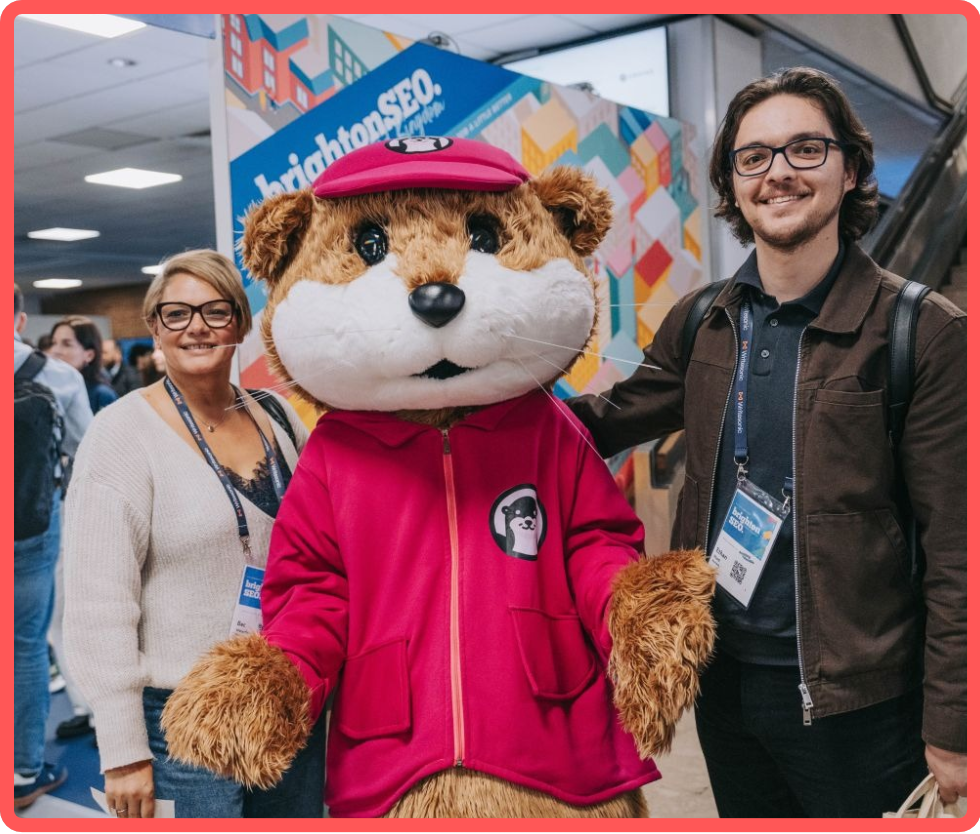
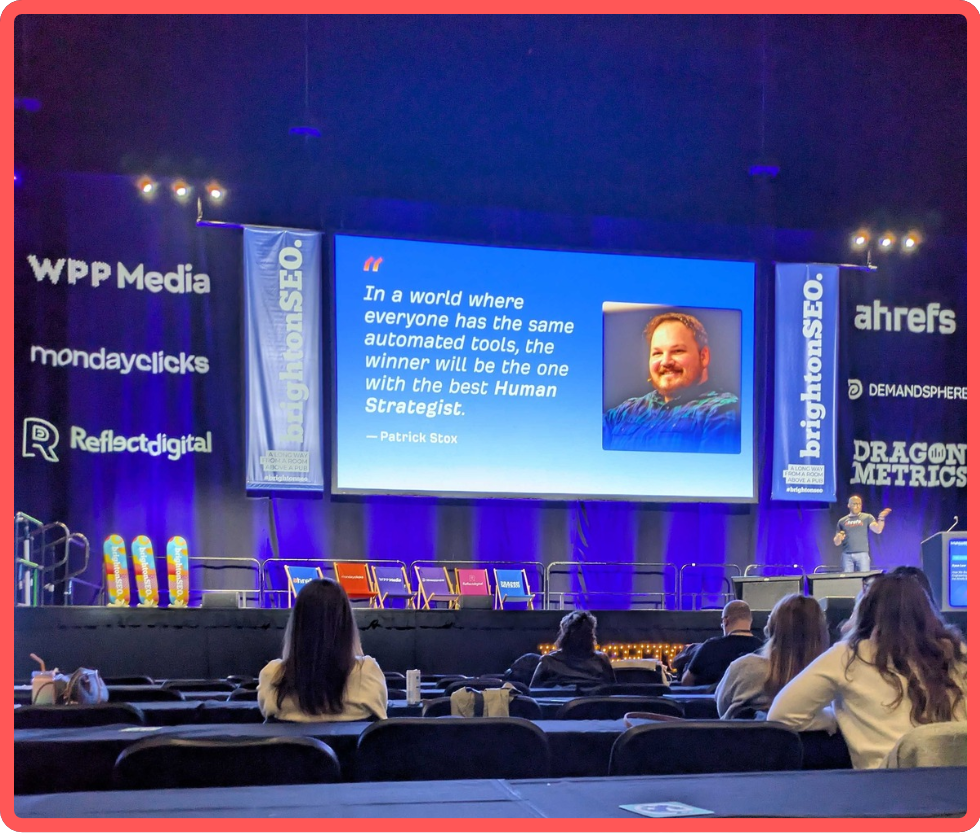
In October, Bec and I headed to BrightonSEO, the world’s largest search marketing conference, spending both days there and coming back with pages of notes and inspiration.
At Blaze Media, we do SEO for businesses across Liverpool and the UK, so we weren’t there for the buzzwords. We wanted to hear from other marketing minds what business owners should actually be doing differently now that people are asking ChatGPT and Google’s AI Mode for recommendations (and, since September, seeing ads in ChatGPT too).
There’s not exactly a shortage of AI search posts and theories out there at the moment, so rather than walk through and rehash every single talk, we’ve pulled some of the most interesting ideas together into one big recap, with ideas grouped into themes, and the relevant speakers linked throughout so you can follow their work.
At least one of the points recapped below is sure to give you a spark of inspiration to try something with your own business or client site, and if not, don’t forget to grab a free SEO audit with next steps from our team.
AI Search Wants to Recommend Businesses
Jean Dejsuvan set the tone for AI search with her talk on getting your brand recognised and recommended by AI agents going forward: Google rewards helpful content, she said, but AI is looking for a helpful product. Schema or clever prompting won’t rescue a business that isn’t worth recommending.
This is a useful reality check, and an easy exercise for site owners. If you can’t say what makes you different in one sentence, an AI assistant is going to struggle to say it for you. Write that sentence, then use the same wording on your website, your Google Business Profile and your social profiles.
With his Halloween film-themed presentation, Greg Gifford added a warning for anyone tempted by shortcuts: Don’t get caught up in the citation hype, because being mentioned or recommended is what really matters. He also warned against quick GEO (generative engine optimisation) hacks, and reminded the room that the basics are still around 85% of the battle in local SEO.
Being Talked About Can Beat Being Linked To
With traditional SEO, a lot of us think of visibility as primarily a link-building and citation problem. RVU’s Eilish Hughes painted a different picture. In Ahrefs’ study of 75,000 brands, YouTube mentions showed the strongest correlation with AI visibility, branded web mentions weren’t far behind, and backlinks only correlated weakly. Ahrefs is clear that correlation isn’t causation, so treat it as a pointer rather than a recipe.
The practical lesson is that AI visibility isn’t owned by SEO alone. Eilish’s talk was called “We didn’t build a GEO team”, and her answer was to get SEO, content, PR, brand and social around the same table each month to decide what to make next.
For a local business, that could provide a more straightforward, holistic approach going forward. Get mentioned in video, in local press and on partner websites, not only on pages that link back to you.
Local SEO Still Rewards the Basics
Local search was one of the busiest topics of the two days, and the advice was refreshingly practical. It’s fairly good news if you’ve already got the basics in place. If you want a refresher, check out our local SEO tips for Liverpool businesses.
Your Google Business Profile Feeds AI Answers
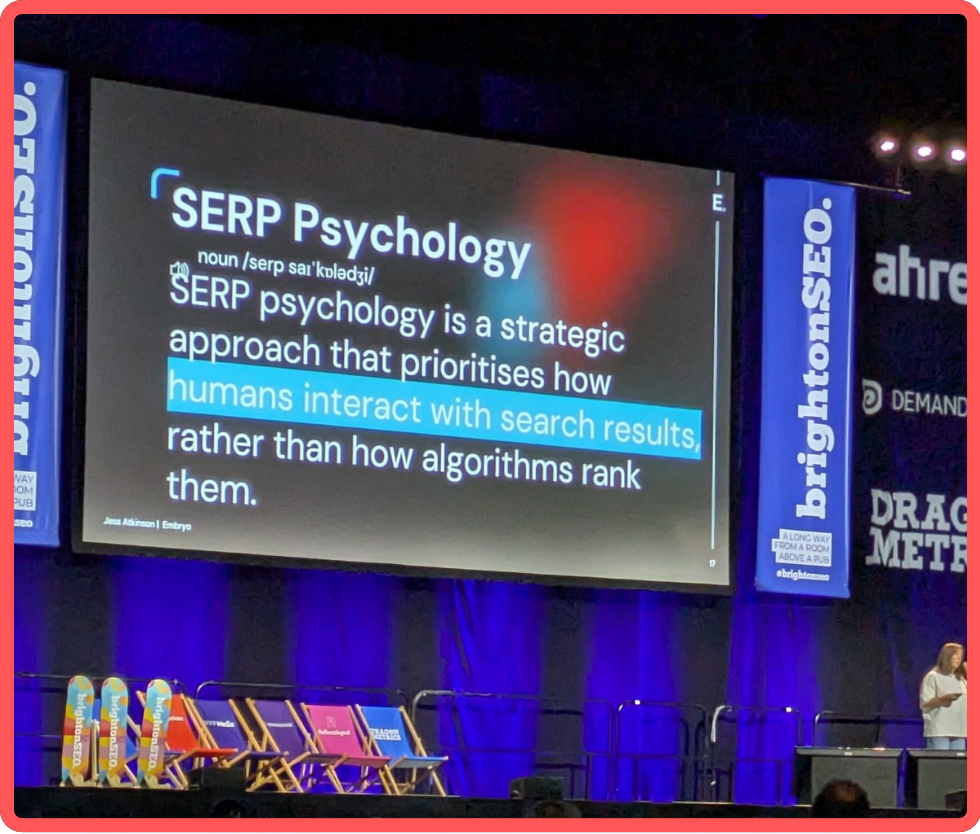
Michel van Luijtelaar from GMBapi showed how closely AI answers follow your Google Business Profile. In one example, AI Overviews changed within 3 to 4 days of a missing service phrase being added to a profile description.
His advice was to write plain sentences that say what you do, who it’s for and where, and to fill in every attribute. Our guide to optimising your Google Business Profile walks through it.
Rating and Recency Beat Review Volume
Reviews came up again and again. AirOps’ Sam Page put it neatly: “40 reviews at 4.8 can outrank 1,000 at 4.” Proximity still comes first, but a strong rating helps a lot. Review recency is an incredibly powerful signal, and Christian Hustle from Uberall agreed that recency and specificity beat volume. In practice, that means asking for reviews little and often, and encouraging customers to say what you did for them and where.
Check Your Listings Beyond Google
ChatGPT’s answers draw on editorial lists, delivery apps and review sites, and in the UK, Yell dominates almost every category. It’s worth checking if your Yell and other listings match your profile, and ensuring NAP (name, address, phone number) consistency for every place AI might pull from.
Local Pages Need Real Local Substance
Templated copy with the city name swapped in looks like a duplicate to an AI retriever, and also generally doesn’t provide much SEO value. For Lyons Estates, an independent sales and lettings agency in Bootle, our SEO case study describes building a landing page for each target area, linked to a topic cluster of information that people moving there would want. Within a six-month period, that helped deliver a 416%+ increase in non-brand traffic.
Write Answers, Not Just Keywords
Keywords still matter, but a theme running through several talks was that AI search doesn’t treat your page as one big block. John Iwuozor explained query fan-out: AI search splits one question into lots of smaller ones, then picks the best passage for each. In his words, fan-outs are the new keywords. A patent shows what Google has explored rather than what it uses today, so we treat this as direction, not a rule.
Make sure your pages can be retrieved, not just ranked, by checking crawling, rendering and internal linking first. Then make your most important pages work as self-contained answers.
In practice, that means clear headings, the answer in the first line or two, and sections that still make sense if they’re lifted out on their own. Our guide to AEO (answer engine optimisation) vs SEO goes into more depth on this sort of thing.
Structured data came up too. Yoast’s Alex Moss argued that schema works best as a connected graph, because it reduces ambiguity for AI. Rather than chasing every new protocol, his advice was to get the foundations underneath right. If you’re new to the idea, our entity SEO guide is a good place to start.
Accessibility Helps People and Machines
Tania Gerard made the case that screen readers and AI crawlers both read the code behind your page, so fixing it for one helps the other.
Her fixes and checks were concise and straightforward. Describe what an image does rather than what the file is called, unplug your mouse and tab through your page, caption your videos and tidy up your heading hierarchy. She named WCAG 2.2 AA, the web accessibility standard most organisations now work towards, as the practical baseline.
It’s the sort of work that improves the experience for every visitor, which is a rare thing in SEO.
Online Shops Need One Consistent Story
The ecommerce talks were the most technical of the two days, but they all landed in the same place: keep your site consistent and be deliberate about what you let Google crawl.
One Source of Product Facts
David Bryan highlighted that the product page, the product markup and the Google Merchant Center feed should all tell one story, ideally from a single source of product facts. This will only matter more as AI shopping agents start comparing products on shoppers’ behalf.
Margaux Marshall focused on Shopify, with a closing line that applies to every audit we run: not everything you find needs fixing, but everything you fix should have a reason. If you sell on Shopify, our Shopify SEO tips are a good place to begin.
Our own work points the same way. In our City Fencing SEO case study, the new ecommerce site was entirely transactional, so we started with keyword research for category and product pages, meta tags, heading structures and crawling and indexing issues. Clicks went up by 155% as a result.
Measure AI Visibility Simply
Measurement is where AI search talk can get very complicated quickly. What clients actually want to know is whether they can show up in ChatGPT, why a competitor is being recommended and whether AI has them wrong.
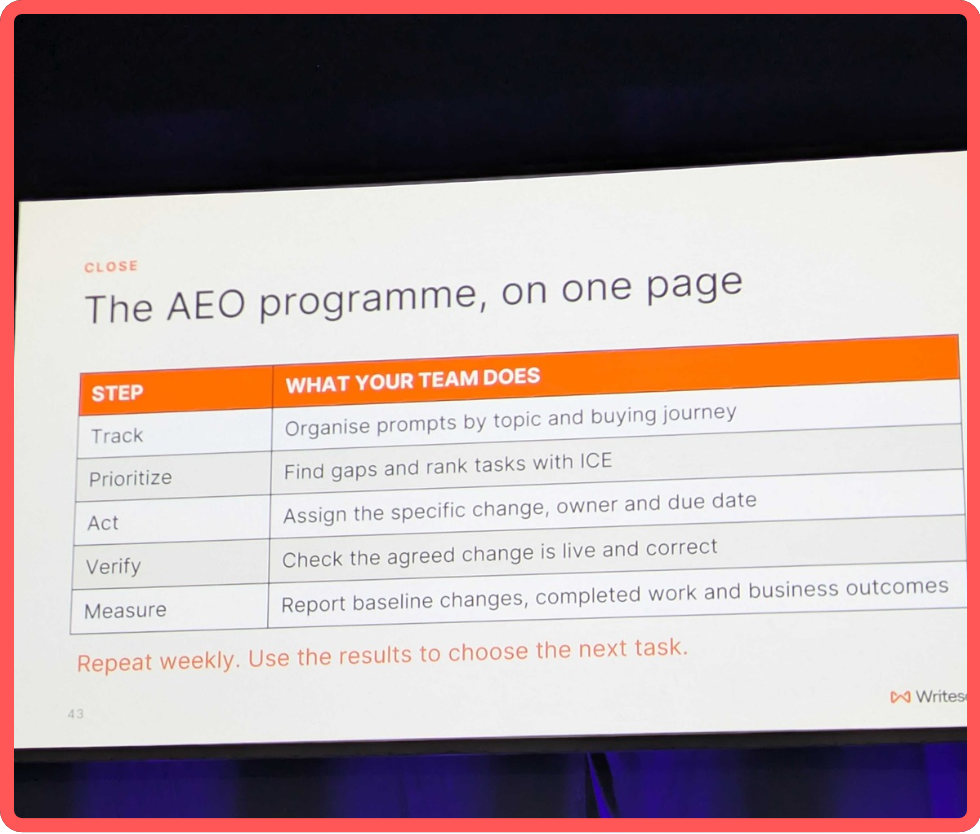
Vishal Mahida offered a short, repeatable check: pick one business, ask a handful of commercial prompts such as “best [category] in [location]”, and record whether it was mentioned, recommended and described accurately. Set a baseline, expect some traffic you can’t see and check again every month.
We’d add one quick job to that list. Set up a separate channel for AI referrals in GA4 now, so you have a baseline before anyone asks for a report. You can also use tools such as WriteSonic in order to better monitor when AI crawlers and bots are digesting your site and content, even when it doesn’t necessarily result in traffic (which it sadly often doesn’t).
What Should Your Business Do Now?
If you only do a few things this month, make them these:
- Write your one-sentence USP and use it everywhere.
- Check that your Google Business Profile and Yell listing say what you do, who for and where.
- Ask for fresh, specific reviews. Make sure your key pages answer their main question straight away.
None of this is revolutionary, and that’s the point. Most speakers treated AI visibility as something that builds on solid SEO, not something that replaces it.
Get Your SEO Ready for AI Search With Blaze Media
AI search is changing what visibility means, but a lot of the fixes are practical and within reach. Our in-house SEO team works on them for clients every day, from Google Business Profiles and reviews to content that AI search picks up.
Not sure where your business stands? We’ll run a free SEO audit and show you your biggest opportunities. Get in touch to find out how we can help you, or read more about our SEO services in Liverpool.